Player Analysis – Thabang Monare
Featured Photo Credit: Gavin Barker/Backpagepix
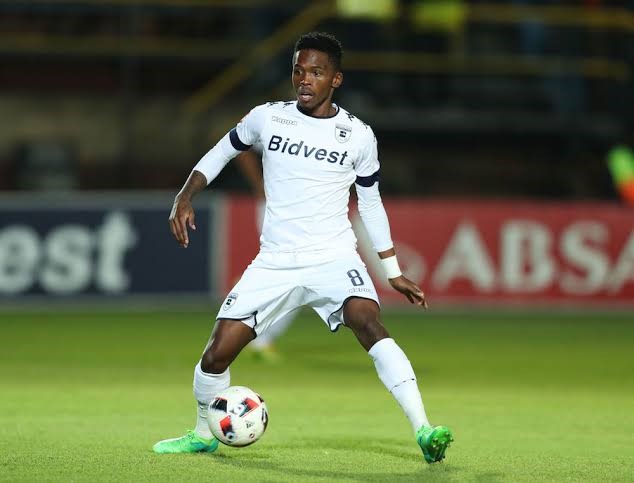
The dust is seeming to settle, and most of Bidvest Wits’ 2019-20 squad have found their preferred destinations – following the status sale of the football club. Thabang Monare, whom most people thought was headed to Naturena to join Kaizer Chiefs – following the appointment of Gavin Hunt.
It was 08h56, on a Tuesday morning of the 13th of October, that Thabang Monare tweeted a ‘good morning’ message to the Twitter community. After that, his replies section was flooded by Amakhosi fans, with many of them wondering if their transfer ban had been lifted. Well, that was not the case, instead a day later he was announced by their Soweto rivals, the mighty Orlando Pirates, where he has found a new home.
Orlando Pirates
With Josef Zinnbauer at the helm at Orlando Pirates, and seeming to be instilling his identity. Zinnbauer looks to play a 4-2-3-1 or 4-3-3 as we’ve seen in the previous two games against Cape Town City and AmaZulu, respectively. In the previous game against AmaZulu, the midfield three consisted of Fortune Makaringe, Ben Motshwari and Siphesihle Ndlovu. With Makaringe the most attacking of the three and Ben Motshwari looking to be the one used the most by Zinnbauer, we expect him to replace Ndlovu in starting lineup.
So, what will he bring to Orlando Pirates?
Player Overview
Under his previous manager Gavin Hunt, who always looked to twitch formations in respect for the opponent that he’s going to face – at times it would be difficult for Thabang Monare to play in one position consistently. In a 4-4-2, Hunt’s most used formation, Monare would be on either side of a two-men midfield, fulfilling defensive duties with pride and great energy. A player who can read the game well, fantastic with the quality tackle and looks to start up attacks quickly after regaining possession.
The roles of central midfielders in a two-men central midfield are often termed as one looking to surge forward and making runs into the box, the other looking to sit deep in front of the team’s defence and screen the passes. Monare has the qualities to perform former, but he executes the latter with high levels of competence.
Defensive contribution
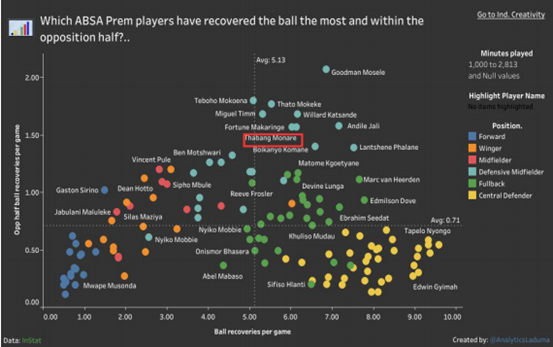
Thabang Monare recorded 76 successful tackles and 124 successful interceptions [Data: @mba_lm], translating to 60% successful defensive actions in the entirety of the 2019/20 PSL season. He further recovered a total of 149 balls, 46 of them being in the opposition half. The scatter-plot below shows how the before mentioned numbers compare against other players in the ABSA Premiership, in terms of most balls recovered per game and within the opposition half.
He presses with speed, positions himself in advantageous positions to force turnovers and or break down attacks in transitions and rest defence moments. He senses where his team is more vulnerable, instead of just occupying central zones – we can see him move horizontally to cover spaces evaded by overlapping fullbacks or wide players that cannot trackback.
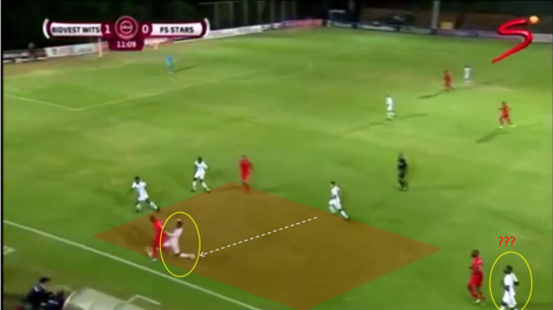
Shuttling wide – In the above illustration, we can see him shuttling across and covering the wide areas evaded by a wide midfielder that is not recovering quick enough. It is a common trend of his game – screening the entire back four and not just occupying the central areas.

These two illustrations above further showcase his superb tactical intelligence, great reading of the game and excellent athletism. He was well-positioned to be able to use his quick covering of ground to successfully regain the ball from an attack in a wide space.
A central defensive midfielder is more inclined to protecting his centre backs by remaining in front of them. However, by shuttling across, a CDM is also protecting the centre back because, like in the illustrations shown above; had he not covered that wide area, he would have forced the centre back to move out of position. Therefore, causing a split between the CB pairing.
Counter-pressing – well, counter-pressing is an idea precisely aimed at winning the ball back immediately after it has been lost, to prevent counter-attacks. This is achieved by players in close vicinity of the ball applying high levels of pressure on the player on the ball – who might be still trying to control the ball and, has not yet appreciated the space he and his teammates are in. This means the player on the ball will not have enough time to rearrange his thoughts or have enough time to play a pass to a teammate in a threatening position.
Although speed is very crucial in counter-pressing, the organization is equally as important. Players around the ball or players who are positioned in particular areas, specifically to assist the team to regain the ball after the loss of possession are supposed to be well distanced to allow the transition to be effective. Counter-pressing has qualitative superiority about it.

In the illustration above, we can see Bidvest Wits being attacked after a loss of possession (picture on the left). However, through superb positioning and great reading of the game, Monare was able to be nearby of the opposition player in possession. We can see him in the second frame regaining possession before the player on the ball could even play through his teammates making runs off the ball.
Qualitative superiority in counter-pressing vs numerical superiority counter-pressing – briefly, qualitative superiority in a defensive transitional phase is positioning players who are skilfully and physically capable of managing to cover ground to breakdown an opposition counter-attack. Whereas numerical superiority focuses more on having a good number of players behind the ball, so the team can have numbers to collectively press the ball in transition – restricting numbers in the attacking phase.
With 46 ball recoveries in the opposition half, Thabang Monare is very useful in counter-pressing. He has the quality to position himself well in attacking phases, so he can successfully prevent the opposition from threatening in transition and also has the competence to engage and successfully win challenges.
Attacking Contribution
In the attacking phase, ball retention is very important, especially in central midfield. Recording 1113 completed passes, translating to an 88% passing accuracy, we can see that Thabang Monare is not just an industrial player – there’s ball quality about him.

The scatter-plot above tells us that Monare is a player that intends to want to create chances for his teammates, averaging just over 1.5 chances created per game. He does not stand-out, however, he is part of the conversation. Being a player that is mostly deployed as a player that is tasked with regaining possession, he is also useful in attack.
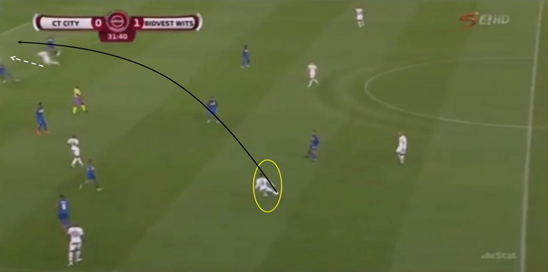
In the illustration above, we can see him looking to locate his teammate that is making a run off the shoulder of the last man. An 88% pass success rate is usually associated with players that play safe and short passes. In the case of Monare, we see a player who is looking to be aggressive with ball possession. Whenever he regains possession, and the moment is right he looks to start attacks using his decent long-range passing ability.
Recording only 15 shots at goal last season we can see that he is not a player that is usually restricted from getting forward, usually because gives a team more defensively. He also has his fair share of possession losses, giving away a total of 91 balls last season, 19 of those being in his own.
Conclusion
Monare usually does well in chaotic and fast-paced games. With Orlando Pirates being a team that is known for high-octane build-up play and attacks, Thabang Monare is a perfect fit for the sea-robbers. The only question that remains is that; who will he replace in the Buccaneers’ starting 11.